Two American Airlines flights nearly collided over Phoenix due to a call sign mix-up, but ATC's swift actions ensured a safe outcome.
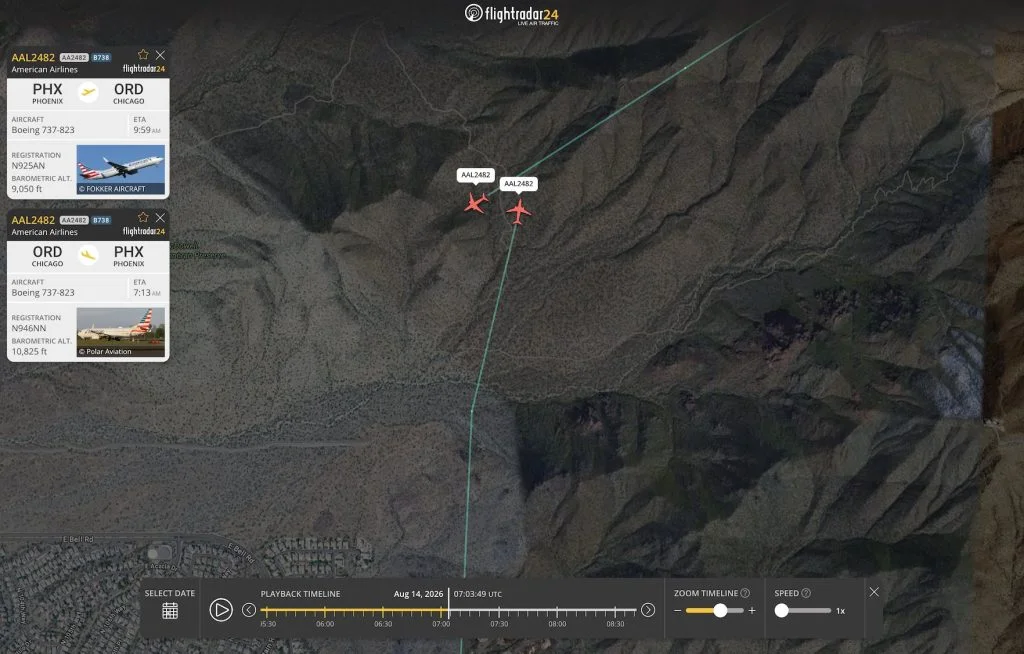
In the early hours of August 14, 2026, a notable incident unfolded near Phoenix when two American Airlines flights—both communicating under the same call sign—shared frequency. American Airlines Flight 2482 arriving in Phoenix was descending through 11,000 feet while another Flight 2482 departing from Phoenix climbed toward 9,000 feet, creating potential confusion for both pilots and air traffic control (ATC).
Upon identifying the dual call sign usage, ATC quickly intervened, instructing both aircraft to maintain safe altitudes to prevent any risk of a conflict. They modified their communications to distinctly address each flight as “American 2482 on approach” and “American 2482 on departure,” clarifying the situation.
The two planes crossed paths without incident, successfully continuing on their routes after the alert adjustments. Such occurrences highlight the critical need for clarity in aviation communication protocols.
A Fundamental Issue in Aviation Communication
Confusion due to overlapping call signs has long been a concern in aviation safety. The complexities of air traffic management demand crystal-clear communication methods. With hundreds of flights operating simultaneously, the possibility of misidentification poses risks that could lead to accidents. This isn't just a recurrent issue; it's a systemic one that aviation authorities must tackle with a comprehensive approach.
There's a nuanced interplay between technology, human judgment, and established protocols in air traffic control. The existing conventions—primarily relying on distinct call signs for aircraft—are increasingly scrutinized. In simpler terms: as more flights take to the skies, keeping track of them all under a limited set of identifiers is becoming more challenging. It’s almost inevitable that confusion could arise when two aircraft are assigned the same call sign at roughly the same time.
In many countries, this issue has prompted serious discussions about a transition to a more sophisticated system. For instance, while airlines in regions such as Europe have started using alphanumeric call signs to mitigate these overlaps, the U.S. has been slower in adopting this change. Proponents believe that alphanumeric codes could provide an additional layer of clarity, particularly during peak travel seasons, but full implementation remains distant.
The Role of Air Traffic Control
Air traffic control plays an instrumental role in preventing accidents stemming from communication errors. In this case, the ATC's prompt action to differentiate the two American Airlines flights—while seemingly straightforward—reflects years of training and protocol adherence. Their ability to swiftly address the overload of similar identifiers likely prevented a serious incident.
However, let’s consider that such immediate interventions are not a sustainable long-term solution. Relying solely on swift ATC responses to resolve call sign confusion may strain human resources, especially during incredibly busy hours when air traffic controllers are already managing numerous flights. If you're working in this space, you might be thinking that tackling the root cause—overlapping call signs—should be a priority rather than merely relying on reactive measures.
The importance of high-fidelity communication cannot be overstated; it is fundamentally about the safety of passengers and crew alike. Technologies like Automatic Dependent Surveillance–Broadcast (ADS-B) have started to gain traction and represent a more advanced layer of tracking and identification, enhancing situational awareness for pilots and controllers.
Lessons Learned from Similar Incidents
Upon examining past cases of call sign confusion in aviation, the industry has documented various instances where similar issues could have resulted in catastrophe. These cases usually reinforce the idea that when aviation technologies become outdated or fail to adapt to modern demands, human error surfaces more frequently. This dual dependency on human operators and technological tools is where safety protocols must advance significantly.
A closer look at previous incidents verifies the point that even a single miscommunication can lead to devastating outcomes. The infamous 2007 incident in Brazil, where two aircraft collided, highlighted the dire consequences of failing communication and situational awareness. While the specifics differ, the underlying problems persist: how do we ensure that every flight is distinctly recognized and adequately monitored throughout its journey?
Call Sign Confusion
Confusion due to overlapping call signs is an ongoing challenge in aviation safety. The industry's current reliance on call signs presents risks associated with miscommunication. Discussions about adopting alphanumeric call signs are worth exploring, but we still await a systematic rollout among U.S. airlines.
Implications for the Future of Aviation Safety
The implications of this recent incident extend beyond immediate safety concerns. They touch on broader issues of how airlines manage their flight operations in the context of a rapidly growing global air travel market. With the anticipated increase in air traffic, the current messaging systems will be further tested.
One silver lining of this incident is the renewed attention it brings to communication standards within aviation. As the industry prepares for increases in air travel, the need for stringent protocols becomes more pressing. This incident can serve as a catalyst for change—not just in terms of call sign protocols, but also in how technology might assist in communications moving forward. Perhaps it's time to look toward innovations that will ensure clarity and safety, rather than waiting for the next incident to trigger a nationwide reevaluation of tactics.
Conclusively, we may find ourselves at a crossroads where adherence to old methods could impede our progress in safely navigating the skies. The challenge isn't just about fixing a call sign issue; it's about fortifying the entire framework of aviation communication for years to come. Whether that means advanced technologies, rethinking the use of call signs, or establishing new protocols, the aviation industry has some serious soul-searching to do—from the flight deck to the control tower.

Discussion
Sign in to join the discussion.